

4 Surprising Things Educators Learned at the [Co]lab (That Weren't Just About Math)
In June, The Hockaday School in Dallas, Texas, hosted The Number Lab's summer [Co]lab. This immersive three-day workshop brought together 50+ educators from Texas and beyond. While most participants were math educators, the workshop also included a diverse range of professionals: school leaders, curriculum specialists, and teachers of science, history, and literature.
Why such diverse interest in a professional development experience focused on math?
The answer lies in the [Co]lab's approach, which positions mathematics as a discipline of reasoning. This shifts the emphasis away from content mastery and "teacher moves" toward creating the conditions that promote deep learning and reasoning. The pedagogy was developed in mathematics classrooms and is conveyed through mathematics at [Co]lab—but it is meant for broader application, developing educators' abilities to nurture reasoning, collaboration, and critical thinking across disciplines. As the four examples below make clear, math is the vehicle, but the insights gained at this year’s [Co]lab were made to travel.
The lesson that feels most difficult might be the one that’s working.
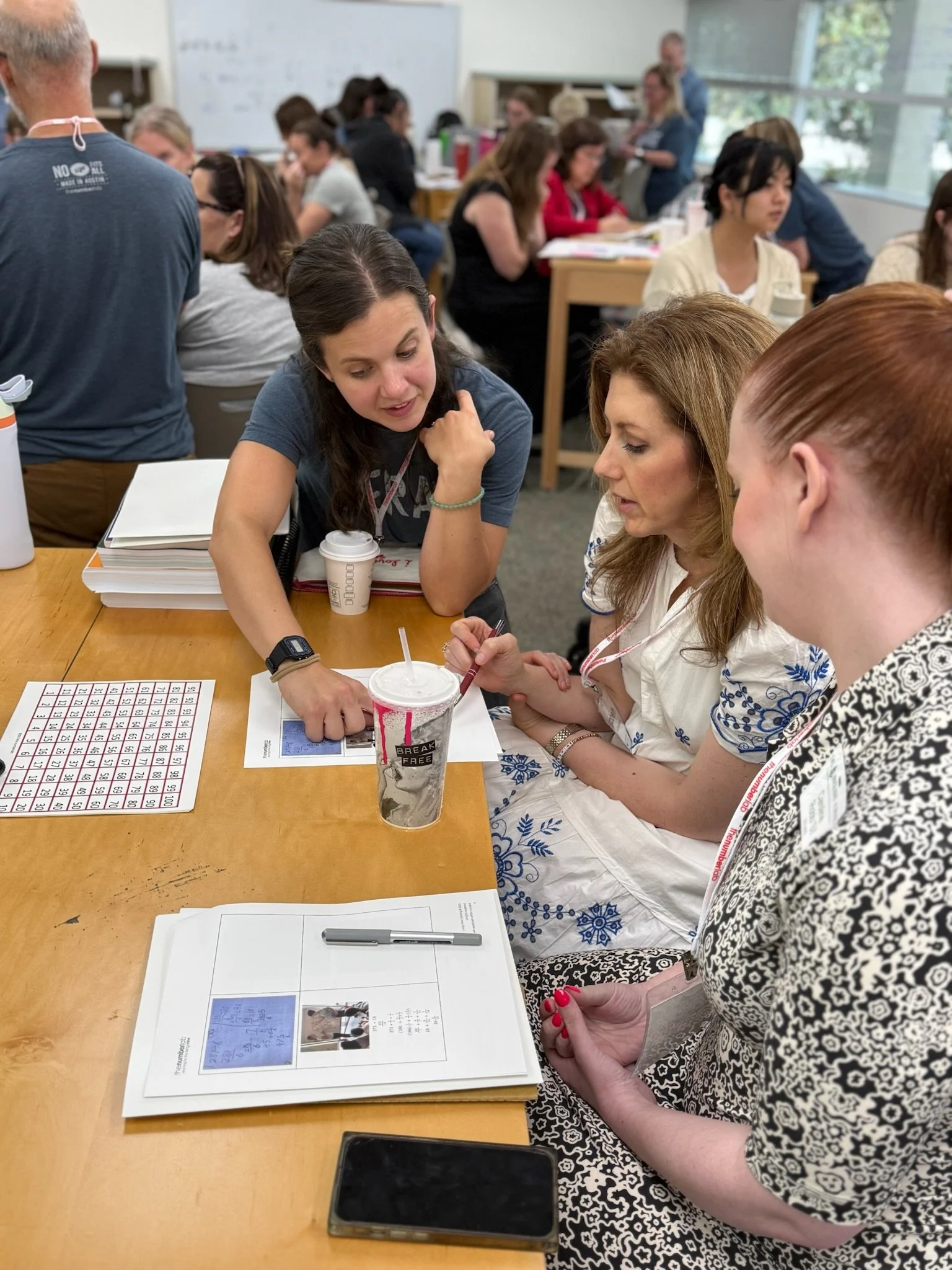
“Begin by doubling six….lose eight…triple that number….” These are some of the prompts that participants worked through together during a 100 Chart Thought Exercise on the first morning of [Co]lab. Though the exercise was straightforward and the math was elementary, the learning that took place and the discussion that followed were anything but.
Asked to set aside paper and pencil, participants noticed how challenging it was to reason out loud with another person, and, as they struggled, how dependent many were on rote methods at the expense of deep understanding. Several participants shared that while the exercise pushed them outside of their comfort zone, the struggle was ultimately worth the reward: asked to clarify their own thinking and to attend to the thinking of others, they recognized the potential for creativity and depth that are lost when we care more about the solution than the thinking that produced it.
What participants discovered for themselves is backed by the research. Studies show that the discomfort of struggle can produce a “feeling of difficulty” that students and teachers misread as a sign that learning is not happening: students who learned more actually judged that they had learned less.Teachers can help students and families to reframe that discomfort—not as a sign that something has gone wrong, but as evidence that real thinking is underway. The lesson that feels easy might not have been the one that worked.
The most powerful teaching move is not to give the answer.
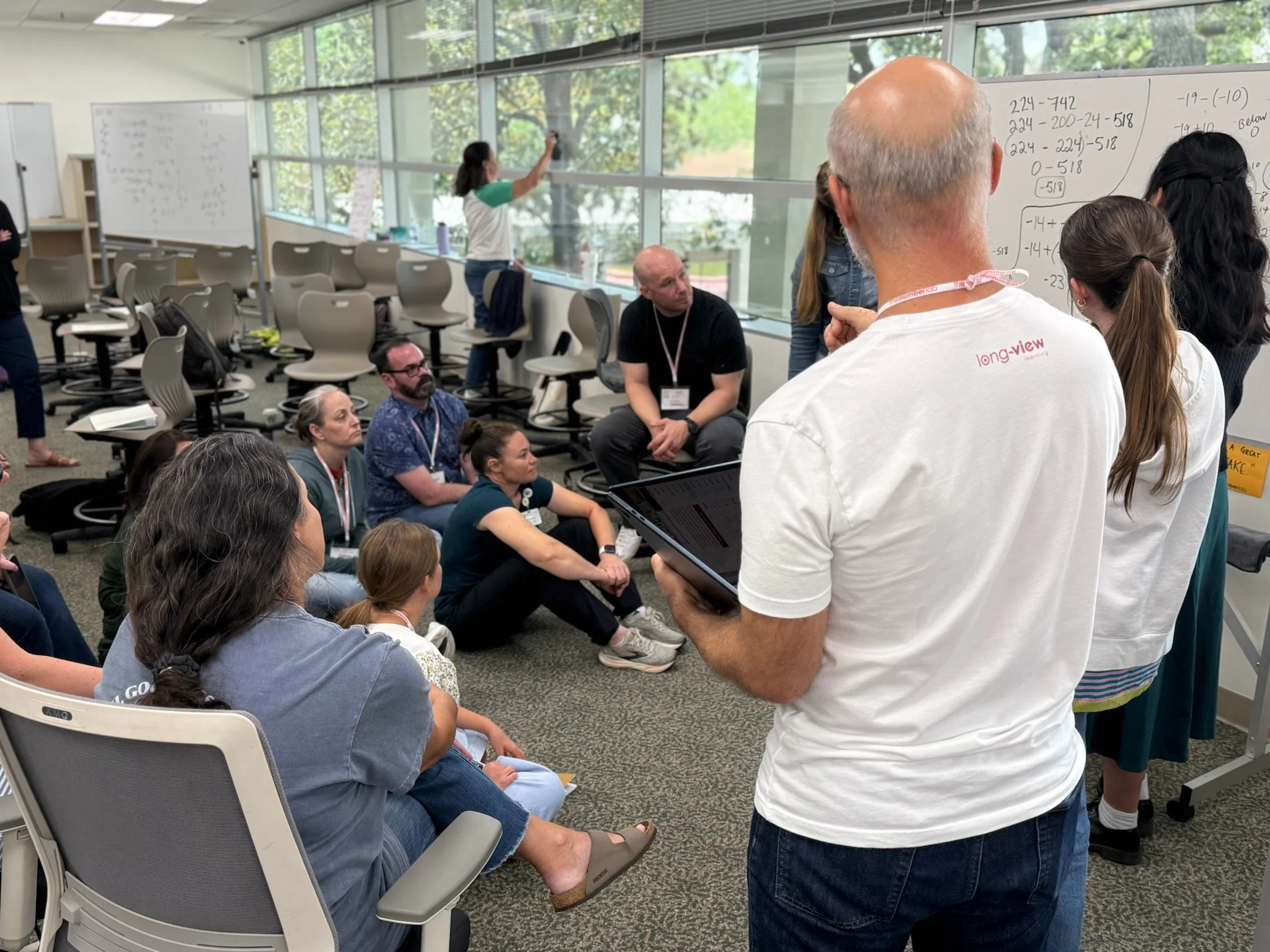
"We're here with you. Do you need think-time, or do you want me to ask a question?" With that, a series of questions followed, allowing the struggling mathematician to find her way to a solution. Kaylie did not rescue; she did not rush. Her patience was palpable, as was her focus on the mathematician she was working with at the whiteboard.
This scene began when a courageous participant volunteered to go first to simplify an expression and place its value on a number line. The confidence that brought her to the board, however, swiftly fell away, and she found herself stuck. The room could feel her anxiety and, as was revealed in the debrief that followed, struggled not to jump in and tell her how to proceed, i.e., to "rescue" her by providing an answer.
This moment during a Number Line Thought Exercise on the first day of the [Co]lab brought a familiar challenge into focus, and pointed a way through it. “Ask don't tell” is a common directive in schools of education, and a notion that most teachers would embrace in a discussion of best practice. It is also a notoriously difficult method to realize effectively in the classroom.
Research confirms that teacher responses to struggle matter enormously: the same student struggle can be productive or unproductive depending on whether the teacher probes, affirms, waits, and asks the right questions, or if they rescue: whether by "giving it away" in the moment, or singling out those who "need more support" for extra time outside of class. The example from [Co]lab was a case in point that deep learning can take place when following the thinking of another and that leaning into productive struggle can create openings for learning that impact everyone in the room; but whether or not that struggle is truly productive depends on the quality of questioning that takes place in those moments.
The discipline of deliberate questioning is a refusal to take the thinking from a learner. Reasoning is not a skill that can be handed to a person. It is grown through experience. So the question educators must ask themselves when they feel the impulse to rescue is, “What can I ask to keep them reasoning?” The cognitive work is the job of the learner. The job of the educator is the question itself.
The group did not press on to "finish" the number line, which surprised some at first, but as the debrief proceeded it became obvious that was the right move. So, was all that time worth it? The response from the room was a resounding "yes!"
Meeting an individual where they are, and striving for depth of understanding over breadth of content, takes time. But with presence of mind and the ability to ask quality questions in the moment, an apparently negative experience can become an occasion for deep understanding to emerge.
The richest conversations often happen around the simplest content.
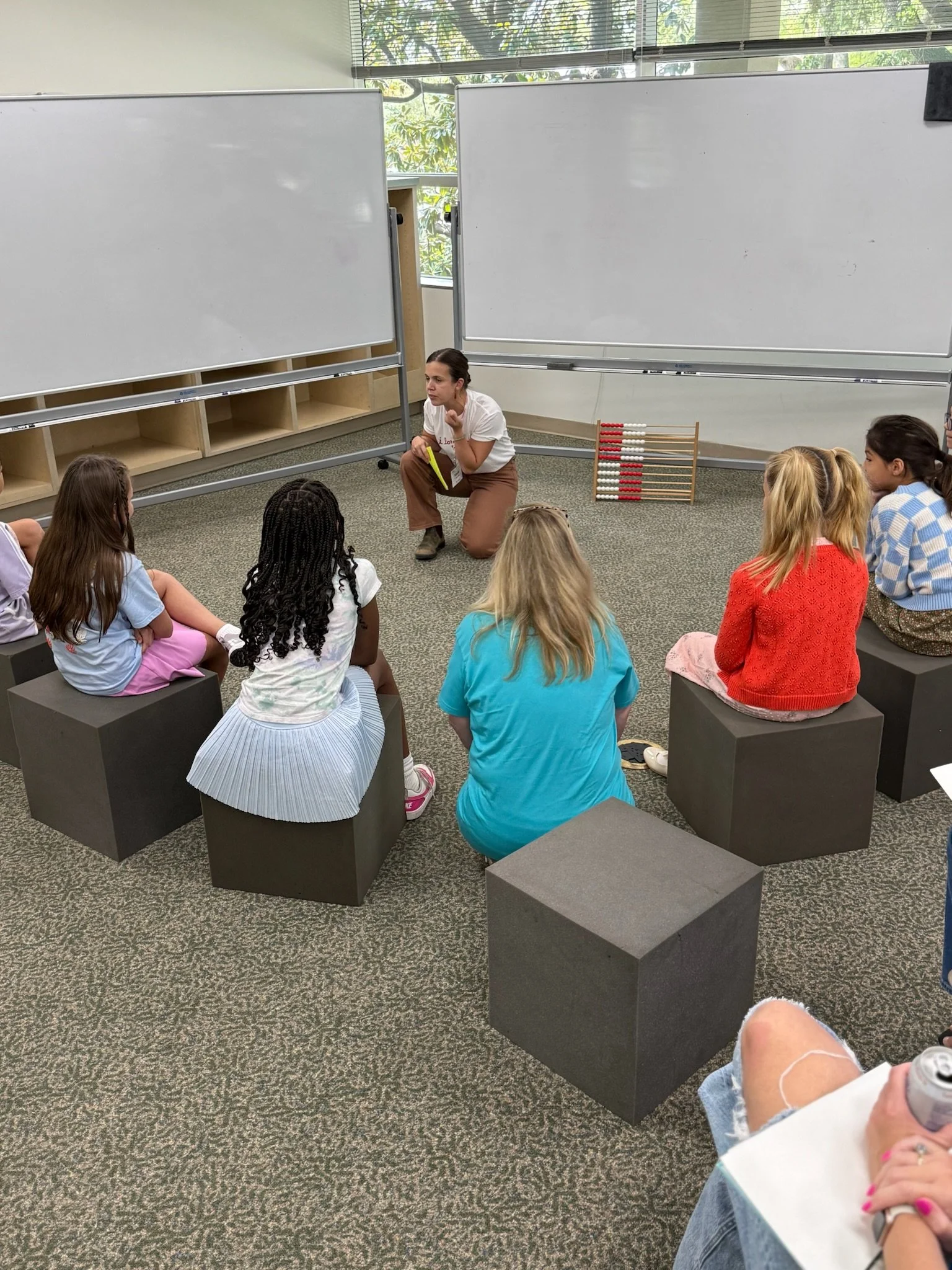
"When we see 5, what does that mean?" This was the opening question posed to a group of fourth graders during a demonstration lesson on the final morning of [Co]lab. The topic of the lesson: addition, a subject many teachers assume to be complete by the end of third grade. What followed was an energetic and wide ranging discussion during which mathematicians explored the concept of number, discussed different ways of expressing equal quantities, and, by the end, were building on and questioning one another.
What observers did not see were kids running familiar algorithms and being celebrated for arriving at the correct answer. They saw a learning community building knowledge together in a dynamic set of interactions, an approach grounded in research. As research has shown, asking good questions, making connections, explaining one's thinking, and representing ideas are all valuable mathematical acts, not just getting the right answer quickly. When "correct" is the goal, precious opportunities for reasoning are lost. But when the emphasis shifts to the process of learning in community, learning and discussion can be incredibly rich and far-reaching, even when the math in question is elementary. Depth of learning is a function of the way you hold the conversation, not the complexity of the content. As Kaylie reminded everyone in the discussion that followed, "Curriculum is a resource to use, not something to teach." By shifting our practice toward developing reasoning and deep understanding, "We're taking back our profession by growing as mathematicians."
Even math teachers say, “I’m not a math person.”
During a discussion about how mindset and content knowledge impact teaching and learning, a potent question was offered that stopped the room in its tracks: "Why is it culturally acceptable to say, 'I'm not a math person,' even for math teachers? What is a 'math person' anyway?"
We never hear, "I'm not a reading person," for example, yet most of us have heard, or said ourselves, "I'm not a math person." Math gets casually disowned, as several participants reported, even by math teachers themselves. Though it may not be immediately apparent, research indicates that this ubiquitous attitude, rarely questioned, is not benign. In fact, it suggests the opposite: how teachers feel about mathematics—their anxiety, their identity, their beliefs—travels directly to students. A teacher's mathematical knowledge is enacted in how they listen to students, what they notice in student work, and the questions they choose to ask. Developing content knowledge is inseparable from developing instructional practice and a positive identity as a mathematician and teacher.
One piece of research was particularly potent for the educators present in the room, many of whom were teachers at the all girls school hosting the event. A 2010 study published in the Proceedings of the National Academy of Sciences presents evidence that math anxiety in female students is not related to their ability, but to the relationship between student and teacher. The anxiety of female teachers was correlated with students holding gender-stereotyped beliefs about the math abilities of boys and girls. And the internalization of these stereotypes in girls is correlated with lower math achievement.
Whatever we teach, our relationship with the subject matter is part of the lesson. This means that developing our relationship to the content we teach is not separate from teaching it—it may actually be the deepest form of it. And this cuts both ways: if a teacher's uncertainty and anxiety can be transmitted to a child, so can their curiosity, confidence, and love.
On the last afternoon participants were asked to reflect on what they will take away from their experience at [Co]lab. Their responses were varied, but a few central themes emerged: the role of building community and positive identity; the power of asking deliberate questions; the importance of cultivating a positive relationship with the material you teach. One more important thing they noticed is something you may have already yourself: almost none of the core takeaways are limited to math; they're apt for broad application in virtually any classroom. The insights from the 2026 Summer [Co]lab were built in a mathematics classroom, but made to travel.