

The Math Vocabulary Shift Every Elementary Teacher Should Know
Ask most elementary teachers what makes math hard for their students, and you'll hear about fractions, word problems, or long division. Rarely will anyone mention the vocabulary itself. But the words we use to teach math shape how students understand it—and how they feel about it.
Math anxiety starts with language
Teacher math anxiety has been linked to lower student achievement, and professional development that deepens teachers' own conceptual understanding of the math they teach tends to produce stronger gains in student learning. Vocabulary is one of the most overlooked levers for building that conceptual understanding—for teachers and students alike.
Here's the good news: some of the highest-leverage changes cost nothing and take no extra prep time. They just require rethinking a few habitual phrases. It's a shift we see pay off repeatedly in our work at The Number Lab, where we partner with teachers and schools to move instruction toward deeper conceptual understanding rather than another set of rules to memorize.
Five vocabulary swaps that build conceptual understanding
1. "Expression" instead of "problem"
Asking a student to simplify an expression is more mathematically precise than asking them to "solve this problem,” and it sidesteps the negative connotation that "problem" carries for students who already feel anxious about math.
2. "And" instead of "plus"
Read 4 + 3 as "4 and 3." The word "plus" implies a gain, which works fine for positive integers but breaks down the moment students meet negative numbers. "And" simply means values are being combined—a phrase that holds up across every number type students will encounter.
3. "Losing" and "debt" instead of "minus"
"Minus" is a word with no meaning outside of subtraction itself. Reading 10 – 4 as "ten losing four," paired with a vertical number line, gives students an intuitive model of subtraction they can extend to integers—including the language of "debt" for negative amounts. This also solves the classic "you can't subtract a bigger number from a smaller one" misconception that resurfaces the moment students hit two-digit subtraction with regrouping. In reality, you absolutely can "lose" more than you have—you just end up with a debt.
4. "Groups of" instead of "times"
"Four times six" is genuinely ambiguous to a young learner: is it four groups of six, or six groups of four? Reading 4(6) as "four sixes" or "four groups of six" clarifies exactly what's being counted and how many groups exist. It's also the phrasing that transfers cleanly to fraction multiplication: "½ x 32" becomes far more accessible when read as "half of 32."
5. "Divided into groups of" instead of "goes into"
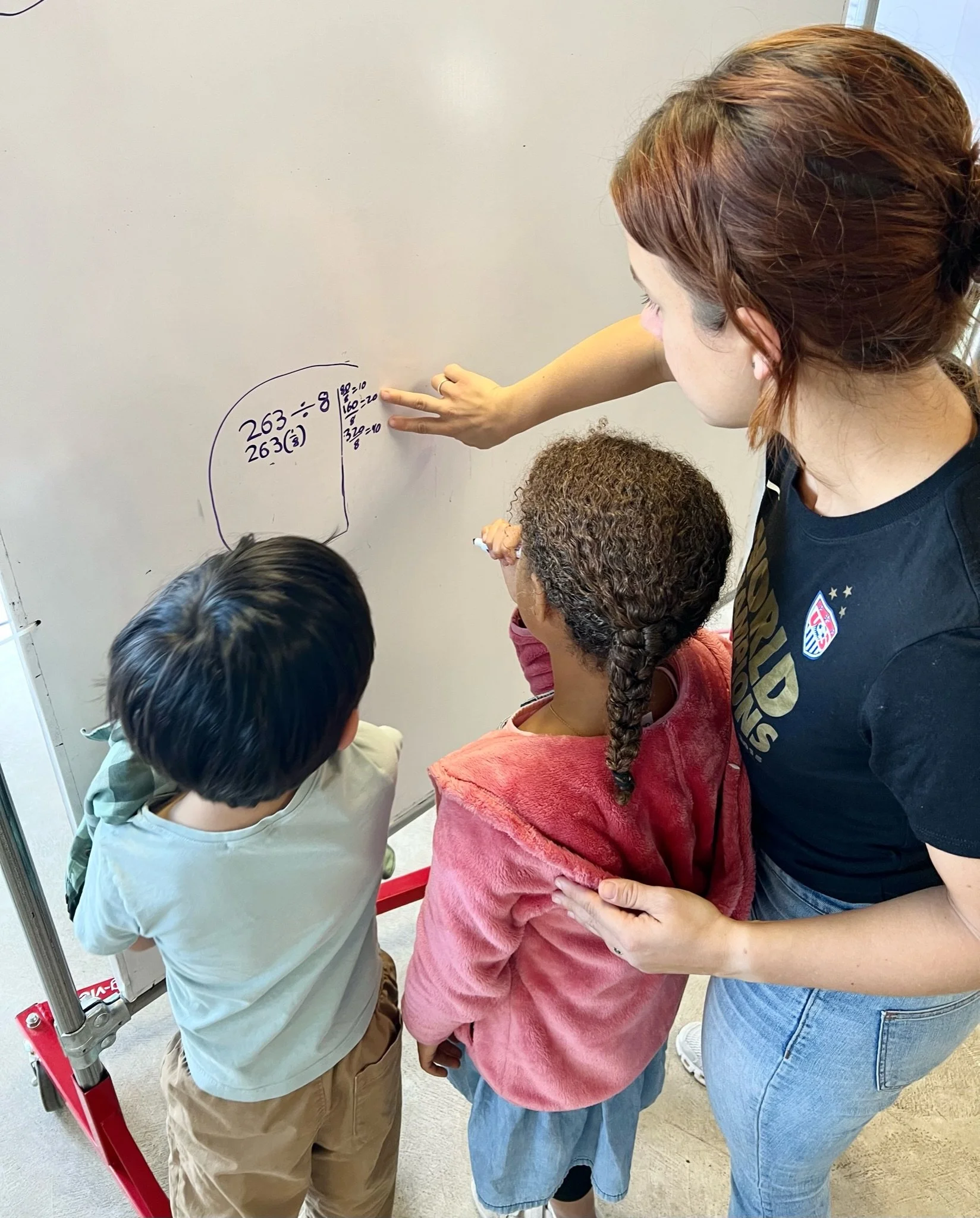
In long division, asking whether 8 "goes into" 3 ignores the actual place value of that digit (which is really 300, not 3) and offers no conceptual anchor. Framing division through its relationship to fractions—320 ÷ 8 as "320 divided into groups of 8," or 320 × (1/8)—builds a bridge between division and fractions that most traditional instruction misses entirely.
The takeaway
To be clear, none of this means students should never learn "plus," "minus," "times," or "goes into." They will encounter that traditional vocabulary—it's the language of textbooks, standardized tests, and every math conversation they'll have outside this classroom. The point isn't to replace it permanently. It's about sequencing: in the early stages of conceptual development, language functions as a model for thinking, a bridge that either supports or distorts the concept a child is trying to build. Get that early bridge right, and the traditional vocabulary can be layered on later without undoing the understanding underneath it.
None of these changes require new curriculum or new training programs. They require noticing the words we default to, and asking whether they actually describe the math, or just the habit.
As Mark Twain put it, the difference between the right word and the almost-right word is the difference between lightning and a lightning bug. In math class, that difference can be the line between confusion and understanding.
This kind of vocabulary shift is at the core of what we do at The Number Lab—helping teachers and schools rebuild math instruction around real conceptual understanding, one deliberate word choice at a time.
Want to see children utilizing this language? Watch the Language As A Model For Thinking Playlist. Download our FREE Language Anchor Chart Here.
References: Hadley, K., & Dorward, J. (2011). The Relationship among Elementary Teachers' Mathematics Anxiety, Mathematics Instructional Practices, and Student Mathematics Achievement. Journal of Curriculum and Instruction, 5(2).