5 Words to Stop Using When You Teach Math (and What to Say Instead)
Math vocabulary is so automatic that most of us never question it. "Plus." "Minus." "Times." "Goes into." "Problem." We learned math with these words, so we teach math with these words.
But a few of them are quietly working against student understanding and swapping them out costs nothing.
1. "Problem" → "Expression"
"Solve this problem" frames math as something to struggle through. "Simplify this expression" is more accurate—and it's one small way to strip out the negative connotation before it takes root.
2. "Plus" → "And"
"Plus" implies gain, which is fine, until negative numbers show up. -4 + -3 = -7 isn't a gain; it's more loss. "4 and 3" simply means the values are being combined, and that meaning holds up no matter what form of numbers are involved.
3. "Minus" → "Losing"
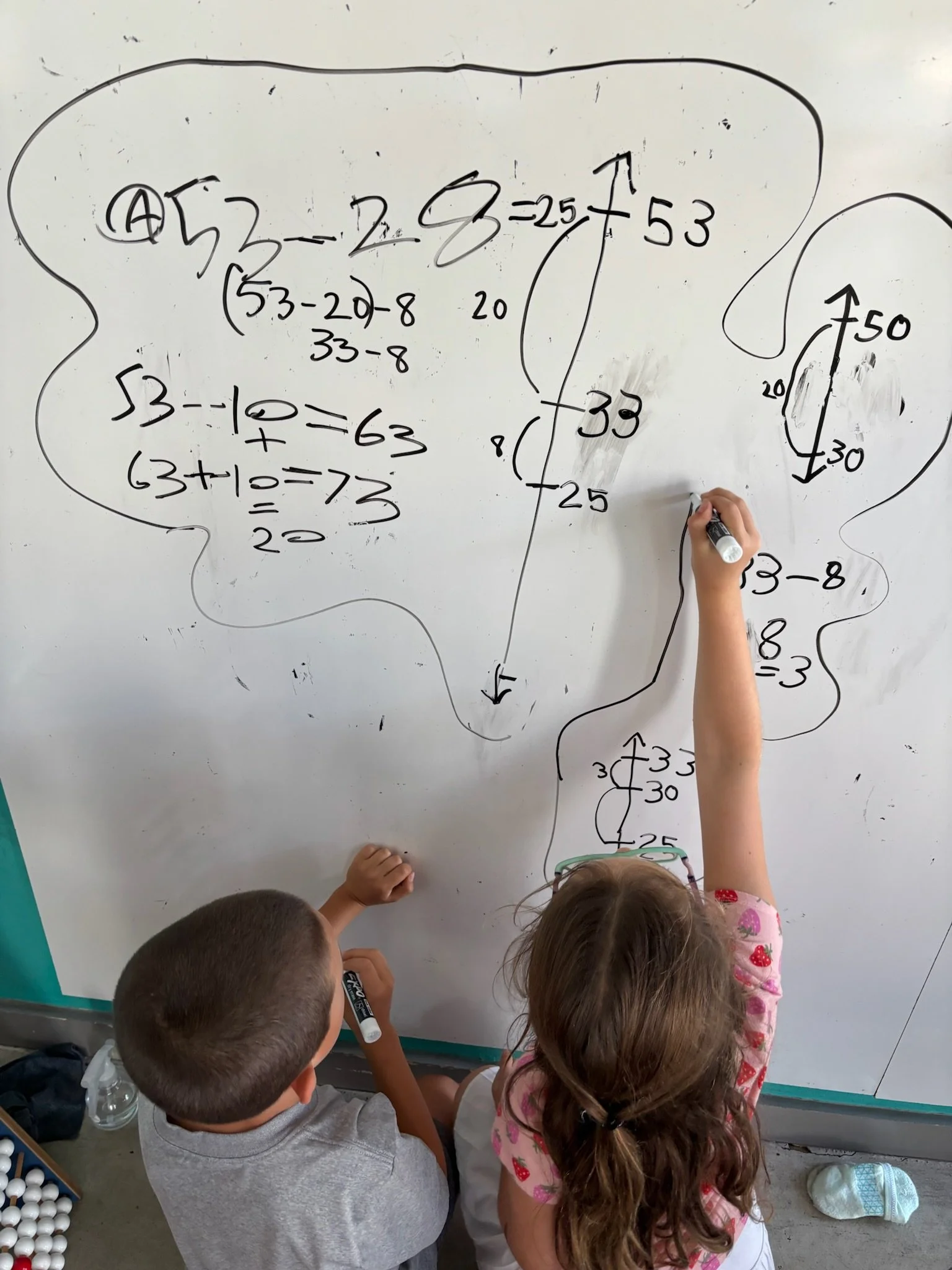
"Minus" doesn't mean anything outside a subtraction problem. "Ten losing four" gives kids something concrete to picture—especially in tandem with a vertical number line—and sets them up to understand negative numbers and "debt" without having to relearn subtraction later.
4. "Times" → "Groups of"
"Four times six" leaves a real question unanswered: four groups of six, or six groups of four? "Four sixes" or "four groups of six" removes the ambiguity and makes the jump to fraction multiplication ("half of 32" instead of "one-half times 32") far more intuitive.
5. "Goes into" → "Divided into groups of"
Asking whether 8 "goes into" 3 skips right past the fact that the digit "3" in 320 actually represents 300. Framing division through its relationship to fractions—"320 divided into groups of 8"—builds real conceptual understanding instead of a memorized rule.
Why this is worth the effort
It’s worth saying clearly: none of this means ditching "plus," "minus," or "times" for good. Kids will of course hear and need to know that traditional vocabulary—it's what shows up in every textbook and test they'll ever encounter. This is about pairing language with conceptualization, not replacing all math terms. In the early stages of conceptual development, the words a child hears aren't just labels; they're the model their thinking is built on. Get that early model right, and the traditional terms can be added later without disturbing the understanding underneath.
These aren't cosmetic changes. Each one removes a small misconception before it has the chance to form: the kind that otherwise resurfaces years later, when students hit negative numbers, fractions, or algebra and have to unlearn a rule that only worked for a limited set of numbers.
Language is one of the simplest, highest-leverage tools teachers and parents have for building real math understanding. It costs nothing to change the words. It costs a lot, later, not to.
This is the kind of shift we help schools make at The Number Lab—working with teachers to build math instruction around genuine conceptual understanding, starting with the words we use every day.
Want to see children utilizing this language? Watch the Language As A Model For Thinking Playlist. Or read more on this topic: Math Vocabulary Every Elementary Teacher Should Know.
Download our FREE Language Anchor Chart Here.